
A Look at the Portuguese World


Yvette Vieira
556 tons of fruts and vegetable save from the garbage


The cooperative consumption of ugly fruit (CCUF) created in November 2013 collects fruit and vegetable products that are not accepted by supermarkets.
With the motto "beautiful people eats ugly fruit", the CCUF has already passed the mark of the 500 tons of fruit and vegetable products that were not wasted. The network "ugly fruit" has seven delivery points in different areas of Portugal and has 3062 registered consumers who, through an annual quota of 5 euros, collect their baskets with fruits and vegetables of the season that are normally rejected by large supermarkets, because they do not meet the parameters imposed in terms of color, shape and size.
The cooperative welcomes 123 producers from various regions, where volunteers collect small vegetables, the so called not suitable fruits and vegetables that other wize farmers could not ooze. The fruit and vegetable creel is then collected by consumers at one of the pre-defined points, with prices running at € 3.5 and € 7 depending on the size of the baskets.
With this initiative the CCUF is able to avoid the weekly waste of 8 tons of fruit trees that would otherwise end up in rubbish, fighting from their point of view a market inefficiency.
Another objective of this associative movement is to change consumption patterns and generate a market of value that combats the food waste and the unnecessary expense of resources, taking into account that in Portugal alone, about 30% of the fruit produced is wasted because, despite being tasty and of quality, does not have the desired aspect.
If you want to join the "ugly fruit" just go to the link:
The musical outsider


The name Surma means to leave its mark on the world, it is associated with originality, daring, competitive spirit, independence and willpower, all synonyms that perfectly fit the alter ego of Debora Umbelino, the creative mind behind this unique and strange musical project as she defines herself.
Tell me a little bit about your creative process to create a melody? Do you use samples of various types and can you give me a review of how this works?
Surma: It's a bit been on the top of the moment, one day I record a sound on my cell phone and sometimes I work from it to a melody. Other, I grab the synthetizer when I'm at home. I also wake up at night when I have ideas in my head, I get up at four in the morning, work them through the night and then go back to bed in the morning. It is what I remember at the time and I just starting to work on that sound.
After these sound sections, the ideas do you have over the course of days and then put together all that you record for a theme?
S: I do not have a very defined structure, like for example in pop music, where there is a chorus, verse and melody. I try to connect the rhythms with each other, I work with the synthesizer on top, I add the voice to complement, it's like a layered construction. Since I work a lot with loops the music happens on that basis and then I build it from there.
You have been on tour and in this period have you written themes for your next EP?
S: Yes, I have recorded some songs with an Omnicord record band as well and we are almost finished with the album's pre-production. I still have a few melodies, I have worked during the day to complement some songs from the album, I also develop some lyrics, but there is still a lot of work to be done.
And when you release this album what's the general idea? In terms of soul what will it be?
S: The general idea is that it's going to be very genuine, because it's all done right on the moment. Then I go to the studio and work a lot on music. I have a theme where we hit some castanets in each other and worked on that sound, or the sonority emitted by a pen closing. It is a bit turned to science, I cannot explain this concept very well, it is based on details and noise.
You are very different even in terms of image, unique in terms of music too, how do you fit into the Portuguese national scene?
S: I do not know, it's a question that it is been ask to me several times, they even question me about the genre with which I identify myself and I do not know how to answer, because I do not even know where I fit into the national music scene. I'm experimental and strange at the musical level, I feel like an outsider to be honest.
And your audience, now that you're touring, did you notice who they are?
S: I think it's 8 to 80 years old, because I see a lot of kids in the audience and then I see people over 50. It's a very comprehensive audience, but by the way I notice it's a lot more from 25 years old up.
Let's talk about the tour itself in Europe, how was the acceptance of your music in terms of the foreign audience?
S: It was one of the best experiences I've had so far, I was a little afraid of people and whether they liked it or not, but overall it was brutal. They always reacted well in the concerts, we always had compose rooms and the ones that were there even entered the atmosphere of each concert, I think it went very well indeed. Then we grew more like artists at the music level, like people too, and we got a lot out of it.
And the concerts at the national level? How are they running?
S: The concerts outside are different from inside, because they are different public. I do not know. But, I can ot complain, even in Portugal the reaction has been very good. It will do the same, I have had a lot of support from the people and the audience that attends the concerts.
Have you ever wondered when you are going to release this EP?
S: Yes, the album is due in September.
And you have a title planned?
S: I have more than one, but none of them are planned for the album. I do not have a fixed one.
The wizard of calheta

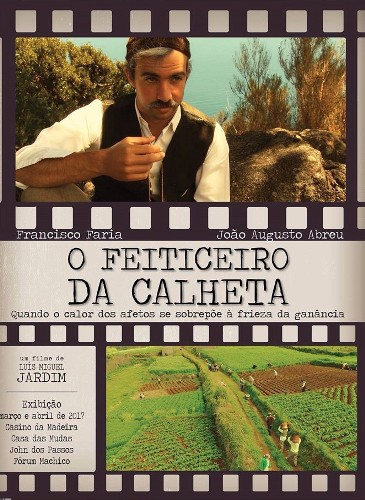
Luís Miguel Jardim's film is a fictional work about the life of João Gomes de Sousa, a well-known Madeiran popular poet who lived in the town of Calheta in the first half of the 20th century. This feature film is a tribute to this personality, but not only, it is also a portrait of the rural life of the island of Madeira at a certain time and its idiosyncrasies. It is a cinematographic project developed and produced by pure passion, that counted with the participation of 400 more people and an original soundtrack, of the Madeiran composer João Augusto Abreu.
How is it that someone who has nothing to do with movies has a chance to make a movie about the "Wizard of Calheta"?
Luís Miguel Jardim: I have as a basic training law, but I have been doing cinema for a few years at Jaime Moniz High School for at least nine years. The "Wizard of Calheta" does not appear from scratch, there is a work of experimentation that has been developed over the years and I believe that this film is my fifth feature film, I have already made some documentaries, what distinguishes it from the rest is that it is an independent production. It does not happen without more or less. The theme comes from a challenge launched by professors Eva Natália and Eugénio Perregil. It is not the result of a biographical note, it is a fiction film about the experiences of the so-called "Wizard of Calheta" and João Gomes de Sousa.
Let's talk about the script that has not only addressed this personality, but which reflects in a certain way a specific period of the island of Madeira and there are many regionalism in the lines.
LMJ: Exactly. The "Wizard of Calheta" has a series of sub-themes, one of them the colony, which was a regime of exploitation of land based on a manifestly unjust relationship between the landlord and the settler. It is a historical trait that has marked us and that should shame us, so it should not be forgotten, it must be remembered. In addition, there is also the issue of affection, the relationship between parents and children, and I was careful with the characters of the wizard and the daughter. In practice I do not know if it was like this or not, however, this was the main line I introduced in the story's script and that for me was the most striking feature, this love relationship between father and daughter.
The script also reveals several characteristics of stratification of Madeiran society at that time.
LMJ: In addition to this stratification that evidently went through the question of the colony, we also had the concern of seeking some professions of the time that were abandoned in the meantime, and we tried to emphasize these characteristic traits in both the economic and the social aspects.
The script also has many regionalisms that are no longer used, was there a lot of research in this direction?
LMJ: There was a great research work done by Paula Trindade, who is one of the actresses, by Francisco Faria and also a group of people who have been working in this area to collect information on these regionalisms. It's a pre-production job that needs to be done before you start filming.
I was told that the film took a year to complete. Does this include pre-production?
LMJ: The film took a year and seven months and that includes this pre and post production work.
There are wonderful plans of the island, about the various phases of Madeiran rural life. Have you been filming these different harvest times during this year and seven months? Or was it all staged?
LMJ: No, everything you see is real, except for some sound effects that are put into post production. What happens is that we used color branding in the images.
The film has a very comical side, but also focuses on another issue more dramatic that is suicide that was something very common at that time in Calheta?
LMJ: The issue of suicide is transversal over the years on the island of Madeira, not just in Calheta. It happened on a regular basis and I think it was a phenomenon that was associated with situations of extreme poverty, indebtedness, addictions, especially due to alcohol.
Although it is a fiction movie, it is based on a real personality and there is the famous scene of the golden cord that belongs to the daughter of the "Wizard of Calheta", Maria de Jesus.
LMJ: The gold necklace does not belong to Mary of Jesus. Our initial idea was to use the original, but it was not possible because of the political conditions in Venezuela. We used a very old piece of gold that belongs to one of the actresses, Paula Trindade. Although the Wizard has the dream of giving a gold necklace, in the script according to the narrative instead of offering one, he gave two, one to his daughter and another string for the daughter of the friend who passed away.
As for the people who participated in the film, there are many personalities of the Madeiran society, how was that invitation, why did you bring these people to the film?
LMJ: Many of these people are linked to the political life and not only of our land, as is the case of João Carlos Abreu who has participated in other productions of mine, because he is a personality always linked to the culture and every time I invite him he says yes. Carlos Lélis also has a lot of experience at the representation level and had a theater company. Alberto João Jardim enters the film at the request of one of our actresses, Fátima Marques, who is a close friend, she address him this challenge and he accepted, because since he was already away from active political life, he had more availability and the idea move on, its only condition was to see the script with his lines before. I even had the concern of asking him to grow a beard for a more rude, more country look, something he had never done before. We had the representative of the Republic, Eríneo Barreto, who gracefully accepted the invitation and made a small participation and the scenarios are in São Lourenço palace. All these personalities accepted, because they liked the idea that the film approach the modus vivendi way of the Madeiran society and its traditions. Why were invited? In the case of Alberto João Jardim there were two reasons, the notoriety that the film reached had another impact and I have no doubt of it, because we had antenna time in several generalist social media of the country. It was also a fair homage to the man, I study a lot of the history of Madeira, I made a movie called "Waters" and now the "Wizard of Calheta" and what you notice is that the island was abandoned for many years by the central power and when Alberto João Jardim arrives our demands are heard in Lisbon and even in terms of living conditions everything has improved, of course there were things that were not well done, but in the film there was a text very unique to fit that person, this role could only be his.
Another homage that he did and there was a certain justice in returning to the "Wizard of Calheta" the origin of the famous "bailinho of Madeira".
LMJ: The "bailinho of Madeira", for the information I have and is the current opinion of the people of Calheta, is that it come from the Wizard, the people who met him and the daughter I spoke to also confirmed it, everyone is unanimous, there is no doubt , the genesis of this lyrics and music is from João Gomes de Sousa. As he was a friend of Max, he ended up showing him the theme and there is the story that someone heard in the telephony Max's version of the bailinho, then they told the Wizard and João Gomes de Sousa went to Funchal to wait for the arrival of the Max on the boat and he gave him some money, very little for the song. What I want to show is that he is the creator of a genre, the lyrics he wrote does not match the current version. The current "bailinho of Madeira" results from the arrangements that Max did and if this musician had not entered into this I am convinced that this theme would not have had the dimension that it currently has. Max gave it a musicality and a projection it would not honestly have had, it's a very personal opinion. I think the two are to be congratulated both the "Wizard of Calheta" and Max, because it was a work that was complemented by the two of them, I do not see what I did raise some excitement, are two figures look each in their own way at a theme, with different visions and musical expressions.
He has the idea of passing this film through Madeiran communities abroad. But even if you show the movie, you already considered that you will have to subtitle it?
LMJ: That is not so, for the Madeiran communities there is no such concern, the question of subtitling arises when thinking about the national market, which is not what I love the most, what I have in mind is first to end the regional circuit. We will try to extend this show of the film until the arrival of emigrants to Madeira until August. Of course we already had contacts, there are invitations to show the film in the Azores and the mainland, but they will be considered in due course, we are now very focused on the regional circuit.
Concave


Presentation of the book and exhibition by Fernanda Grigolim appears in simposium Herbert Helder, his whole life to found a poem.
The work of Fernanda Grigolim does not obey the parameters of other interviews that I done, I just extract a part of the talk of the artist about her work in gallery door 33 and show the various ways to discover, feel and enjoy his work.
"My relationship with photography has always been an act of survival. I started shooting right after my grandfather died. I was nineteen and I had won a Pentax MX and decided to understand what it was all about. I remember that the first place I photographed with the camera was Bariri, the birthplace of my grandfather Luiz Grigolin.
The photos were never revealed, I lost the film at home or in the laboratory of the Lasar Segal Museum, the place where I took my first photography course. Then in college, I went through social issues and spent years and years of my life using photography for and with my activism.
"Garoupa Portraits" is a book released in 2010 that took three years to complete. It is a fiction that was born from the need to create contact with the past, to make present the life story of my father, João José Moraes, dead at age 31, when I was only seven months old.
João José Moraes, known to his friends and family as Moraizinho, was a native of Rio Negrinho, born on January 16th, 1949. He spent his early childhood at a place in Congonhas, Camboriú, Santa Catarina. At ten, he moved to Porto Belo with his family.
"Portraits of the Grouper" is a fiction, my father left nothing written. I built a male narrator who had a first encounter with writing. It was also my first encounter as a daughter with my father and with my fictional writing.
My father was a low-middle-class man, who lived in Brazil in the late 1970s in the midst of a military dictatorship. He is a character and narrator, and is presented in the images and in the text. The story unfolds between the years of 1978 and 1980. The book is 64 pages, 20 x 20 (closed). The narrator comments on his life in the city of São Paulo, in Curitiba. However, his digressions and flashbacks always refer to Porto Belo, in Santa Catarina. The name alludes to the first name of the city, the cove of the Grouper. And the Grouper of the book is much more an imaginary city to which the narrator always resorts when writing his memoirs. "Portraits of the Grouper" is not a book of literature, although there is text, the book is part of the photographic ".
Http://www.porta33.com/exposicoes/content_exposicoes/Fernanda_grigolin/fernanda_grigolin_filme.html
Amazon rainforest in danger


According to the National Institute for Space Research (INPE), deforestation in the Amazon, from August 2015 to July 2016 was 7989 km², 29% higher than in the same period last year.
The destruction of the so-called "world lung" released into the atmosphere, according to INPE calculations, 586 million tons of carbon, equivalent to eight years of emissions from all cars circulating in Brazil.
With this behavior the country is away from the goals established by the last UN-sponsored climate summit and is against the developments that were being followed to reduce Amazon deforestation. In fact, it is the first time in 12 years that the loss of these forest areas shows a significant increase, generating almost 50% of greenhouse gases into the global atmosphere.
Losses in terms of virgin tropical forest area have resulted in agricultural or grazing land. However, almost half of the slaughter of these areas occurs illegally. In Brazil, this type of deforestation has as its main objective the agricultural production that results from the growing demand for meat, skins and their derivatives driven by the global growth of the population and the expansion of the middle class, particularly in Southeast Asia. Although the country has had considerable success in slowing the rate of loss of tropical forest to agricultural land, if this trend continues the consequences will not only be felt in terms of climate change but also in an irreparable loss in terms of forest diversity.
According to an unprecedent study recently published in the Journal of Sustainable Forestry, Botanical Gardens Conservation International (BGCI), based on data from its network of 500 botanical gardens around the world, it estimates the loss of 60,065 tree species in the world, of which 14% are found in Brazilian territory. According to this non-governmental organization, Brazil is thus the country with the highest biodiversity of trees in the world, that is, there are 8,715 species of arboreal trees that only exist in its territory and that represent 14% of the 60,065 that exist in the entire planet. Second in the list is Colombia, with 5,776 species, and Indonesia, with 5,142. The list is expected to be used to identify rare and endangered species and to prevent extinction, but also to reinforce the important role that the Amazon jungle plays in the planet.
MFF with participants from more than 11 countries


The 6th Madeira Film Festival (MFF) has an ambitious program with national premieres, celebrities, and new partnerships with this international film festivals.
The actress Marina Albuquerque is one of the confirmed presences for the MFF'17 to present the film of the director Edgar Pêra, "Delirium in Las Vedras", on April 23rd at 6.30 pm, at the Teatro Baltazar Dias. For two decades this actress is one of the best known faces of comedy in Portugal. Born in Lisbon, she was notable for her participation in several television series and soap operas, such as "Morangos com Açúcar", "Ana e os Sete", "Malucos do Riso" and more recently in the "A Única Mulher".
In the cinema she collaborated with Edgar Pêra in several films "The Conspiracy of the Thousand Tympanos", "Virados do Avesso" and "Sudwestern and The Baron". She also worked with the directors Luis Galvão Teles, Michael Sturminger, Inês Oliveira, Jeanne Waltz, Raoul Ruiz, José Abreu, Leão Lopes and Manuel Mozos.
The film "Delírio en Las Vedras" premiered in February of this year, after an anthesis in Torres Vedras and after two years of shooting and post-production, and arrives in Madeira as part of the 6th edition of the Madeira Film Festival.
For the director, Edgar Pêra, "Delirium in Las Vedras is a 3D film, being at the same time fiction and documentary, and joining the spontaneity of the masked to a narrative thread associated with portuguese comedy." The film was shot for six days in the middle of the Carnival of 2015, plus the night of the "burial of the bone" and its experiences. Briefly, this film touches on "a group of reporters inspired by the different styles of television channels, From the tacky channels to the culturalists, from radicals to musicals, from radials to 3D channels, invades the Torres Vedras Carnival, its aim is to guarantee the maximum audience, and they are willing to do everything for it. To be able to blend in with the crowd, thus breaking all barriers and becoming part of the reality of Carnival. "
The protagonist of the film is Nuno Melo, this being the last film of his career as an actor, where he plays two roles, "it's Ermelindo, the reporter for an institutional channel, and Ermelinda, the matrafona by force. That this is an issue that does not interest the elites"clarifies the director. The actor's monologues also have an "autobiographical and humorous character" characteristic of the actor, he added. "We were pointing the camera anywhere and we always had reasons to be interested," said the filmmaker, adding that many of the interviewees are "matrafonas", typical masks in which men dress as women but affirm male sexuality. For Edgar Pêra, the film, supported by the municipality, intends "to be also a vehicle for the promotion of the carnival of Torres Vedras, which attracts about 350 thousand visitors during the five days." The 80-minute film was at the Rotterdam International Film Festival and joins the nearly 40 films already made by the filmmaker. In it, actors playing the characters are Nuno Melo, Marina Albuquerque, José Raposo, Sofia Ribeiro, Albano Jerónimo, José de Pina, Rui Melo, Miguel Borges, Marco Paiva, Jorge Prendas, Miguel Pereira, Miguel Partidário, João Sodré, Marlise Gaspar and the masked torrienses.
For the first time the number of film industry participants increased without the festival having to offer the flights, or accommodation. A positive indication that more people interested in these areas are choosing the week of the festival to get to know the island of Madeira and be live with directors, actors and producers in a week full of films, talks, talks with celebrities and a social program International level.
Night


This play comes from an invitation to the director Graeme Pulleyn that surrounded an almost entirely team of native or resident in Viseu to give shape to this challenge and which features the interpretation and co-creation of Sofia Moura
Persephone, a 5-year-old girl makes an unexpected trip with her mother, from the city to a village in the interior of Portugal, which could be either from Lisbon or Minho, to visit the sick grandmother. She's going to have to sleep alone tonight in the room where her mother slept when she was little. The room is filled with strange shadows, scary noises and a trunk that hides the secrets of the night. Even the teddy bear that keeps her company is not hers. And the great question arises in little Persephone's head. "What's the night for?" Little by little she gains the courage to face its fears and with the help of Dona Noite and the Dark Captain the heroine girl embarks on an exciting trip to the discovery of the secrets of the night.
This show, aimed at a children's audience, ages 3 to 6, and families is an original creation by Graeme Pulleyn and Sofía Moura. In a process of improvisation, which crosses the languages of dance, theater and storytellers, the two artists of Viseu sought to create a spectacle with a strong visual aspect, which draws on the imagination, that moves with the emotions and with a strong narrative Who grabs both kids and adults. The play was conceived as a journey somewhere between reality and the dream, during which Persephone gets to know the creatures and the characters of the night and realizes that the night is a world to discover. Sofia Moura unfolds in the multiple characters of this story that only ends with the sunrise and the chirping of the birds.
This show is a production of Comedias do Minho, a company based in Paredes de Coura and serving the five municipalities of Paredes de Coura, Valença, Melgaço, Monção and Vila Nova de Cerveira.
Technical and Artistic
Production Company Comedies of Minho
Staging and co-creation Graeme Pulleyn
Interpreting and co-creation Sofia Moura
Staging Assistent Inês Amaral Mendes
Lighting design Vasco Ferreira
Direction of the pedagogical project of the Comedies of Minho Alice Silva
VILA NOVA DE CERVEIRA
1 ABR | Municipal Library | 11:00 a.m.
PAREDES DE COURA
23 ABR | Cultural Center | 3:30 p.m.
MONÇÃO
29 ABR | Municipal library | 3:00 p.m.
VALENÇA
13 MAI | Municipal Library | 3:00 p.m.
Explosive summer


These are some of the Portuguese designers' proposals for summer time.
Fashion designer Luís Carvalho was inspired by the style of Debbie Harry of Blondie and thus "Heart of Glass", a collection "with references in the styles pop / rock of the 70s. Its silhouette varies between the crop / long and the Skinny / XL, in materials that contrast between the fluid and the structured where different textures are explored. Details such as stripes and metallic applications appear in evidence or in small details, with a color palette referring to the works of the plastic artist 1970s, Gretchen Albrecht and resulting in an explosion of vivid colors ranging from coral, green, red and blue. " In terms of fabrics there was the designer selected knits with vinyl finishes, cotton twill, cotton, cupro and silk that give a touch of luxury to the coordinates.

"Retrospective" is the motto of Filipe Faísca for the collection that showed in fashion Lisbon, for this spring-summer season, a "Fast. Forward. Play. Again. Stop! Arrived here, what's left? What next? Which way? What matters: the world, me, the other? What values do they have? Who do we shelter ourselves from? What war is ours? What crisis do we live in? What fashion is this? Retro? It all depends on the perspective you look at. The time machine does not stop. Past. Present. Future. Let's call it Retrospective. We are the sum of what we live, of what we learn. Reinvent the days with what defines us, our essence. We have already met? It all depends on the perspective you look at. The mandala pattern is made by Colin Foord and Jared McKay, and is one of the most sought-after designs in the world. The colors ranged from a very diverse palette of yellow sun, indigo blue, chalk white, camel, honey and military and reef green. The tops and hats are of Palmas Douradas Algarve brand, Montblanc accessories and Christian Laboutin shoes.
Antiquities stories


For Rui Afonso Santos, in the preface he writes about his friend, these chronicles of adventures and complicities are delicious, because "with extraordinary delight and pleasure we read these narrations, through which Anisio Franco affirms his strength as historian and adventurer, pioneer of new histographic paths ".
As a rule, when I interview an author of a book I do not take quotes from the texts, but to arise your curiosity about this author and the wonderful and at the same time hilarious stories he has to tell and which I had the pleasure of hearing in another talk on "Dar a Ver" I will highlight two chronicles, the first one, titled, "my mustache" ... "I barely saw her, leaning against the stairs, I swore she would be mine, even with her husband next ot her. But who was she, the brave lady with the unfriendly face and a muscled in the upper lip? "
"The idol"... "An agent of the Republican National Guard presented himself to the president of the Agricultural Cooperative Unid of Manços. With the question about the whereabouts of the Roman sculpture, they answered another: The Saint Antoninho? Things went soured when the idol was reclaimed again. "
I wonder how many years have you made this collection of portraits?
Anísio Franco: This specifically, because collecting began much earlier, was probably focused on 1988, when I had the possibility to buy and acquire pieces of art. At first it was not a collection, it was something I thought was funny, it had to do with what I studied, the portraiture, the portraits and royal series, and then I bought one painting and it became something very serious.
And in total do you have how many portraits?
AF: About 300 portraits, paintings of the ugly, beautiful, tall, thin people, what matters to me is the human figure. There is a humanistic content in this collection, I am interested in preserving the memory of those people. However, they were forgotten and more had the desire for someone to preserve them, a will that was not respected.
Have you been able to find out all the stories in your paintings?
AF: No, I'm glad I did not. I do not like portraits because I know who is represented. I prefer the challenge, it has to do with my art history training. The style and true story of the paintings I bought is what less interest me, for example, I have a painting in the room that I know everything, the name of the author, the painter, who made the frame, the canvas, everything and I only think it is decorative. For me the most important is always the challenge and I'm glad there are many whom I know nothing, because I still have a lot to work and study.
Have you ever wondered why you love this specific artistic area so much?
AF: Yes, already, because I like human beings. It's a humanist question. The people portrayed lived, had their problems, their idiosyncrasies, like that woman with the mustache. I am interested in the respect I have for humanity.
Of all these portraits that he found, was there anyone who had discovered that it was an artistic treasure, not in terms of the person itself, but of the author of the painting?
AF: Yes, of course. I already had pictures that I thought was one thing and after all it was something better. But that is the aspect that least interests me, definitely. Even because I do not want to change them for money, the fact that people think it's wonderful, because it's an artist with a certain value in the market, I'm not particularly enthusiastic about at all. What I care about is good or bad, and there are not many bad pictures for a very simple matter, nobody likes to be poorly portrayed and the painter was always in front of the picture, it is who is there.
Is there a picture of the many who you do not know the true stories and do not include the ones you invents for some of his portraits with which you are obsessed of discovering?
AF: There are some, the question is that over time the true stories are appearing, at least I hope, as I tale in the book, as when I found an engraving where one of my people was portrayed.
How did you make the selection for this book "Antiquities stories"?
AF: It was very difficult, because I had written many stories over the years, more in two magazines about art, "Arte Ibérica" and "L + Arte". Then I did a thematic selection, one about the portraits, another finally about art objects, it was not something that would have been easy for me because there were many other stories to publish and the editorial conditions were not really loose, so I had to reduce and I have to choose the most exciting, the most fun.
The ones you have not published in a book, have you considered using them for other publications?
AF: Yes, already, but in the meantime, everything goes through the editorial issue of this moment. In Portugal, contrary to what happened a few years ago, the author imposed what he intended to publish and now the public is in charge of what they wants to buy and the publishers live of that. Then there are other areas more interesting for readers, such as this tourist spot, I have the " A walk thru Lisbon" and this editorial aspect is much more appealing to the market.
And what do you plan to do with all your portraits when you grow old?
AF: It's one of the issues that worries me, but the collections have to be preserved. Well, I thought they could go to the Lagos museum, for example. (laughs)
Drawing around the footsteps of herberto helder


"We are always obscure, even without asking. Great victory that no one can take away from us. Not even God, if he existed ... Etc ". Phrases like this rise to a large set of illustrations in color and acrylic pencils by Mariana Viana that explore 23 short stories of poetic prose about Herberto Helder's "The footsteps Around."
How does this project arises from "Drawings around of the footsteps of Herberto Helder"?
Mariana Viana: This project arises from a doctoral thesis in the visual arts entitled "The footsteps around Herberto Helder and the illustration as an oniric part" was a work around the book "The footsteps around" in the sense of realizing that type of images or illustrations could work in parallel with the text.
What were the texts of this work that you chose?
MV: It was the complete work. I have been reading the book for a long time, even though I already knew "The footsteps around" a long time ago, then I did a rereading work already thinking about what kind of energetic it could elicit, I put the work aside and started to draw daily during two years, were more than 400 drawings that had to do with the 23 texts as a whole. It was only later that I began to think about how I was going to fit them into certain types of texts, or what texts could go along with the drawings. Subsequently, a book proposal was also made where the remaining illustrations could be included.
Why did you choose a book of prose from all of Herberto Helder's work?
MV: Because it was a book that told me a lot and I really wanted to explore this kind of energy.
What attracted you to the book in visual terms?
MV: This oniric side and this duality between reality and the dream, to walk in this passage between one and another. I think in these texts this is very significant, for me, it evokes these universes very much.
You said that you started drawing very soon, so after two years, how did you select the images for these texts?
MV: It was looking at the drawings, rereading the texts and trying to fit them together. Some of the illustrations were very directly related to some of the particular texts, others could illustrate either. But it was a work in two phases, a first I was drawing in a very spontaneously way and then find out where they fit into the texts.
There are many illustrations with animals.
MV: The texts do not speak so much of animals.
No?
MV: I think so, although it's not explicit.
Knowing that Herberto Helder was an islander of origin, was there any island in this work?
MV: When I look at the final product, maybe. But, it was not an important factor. It is very difficult to talk about our work, only in the end I did some analysis to myself and my work, because I was often surprised at myself and then realized what was there, but it was more a compulsive work and a great involvement with the texts.
After all this work, how did you feel? After deciding everything, what are the illustrations for each of the texts and the knowledge that you had a work.
MV: Empty. I had spied everything. (Laughs) It was two years that had come to an end and hardly anything would come out, everything that was possible for that work had gone out.
Podcast
Eventos
-
MMI- Reabertura de aquário dos bacalhaus
 17-09-2016
O Museu Marítimo de Ílhavo reabre o Aquário dos Bacalhaus, depois de um período de obras de...
-
Cineteatro louletano- Programa Dezembro
 12-02-2016
No dia 15, sexta-feira, às 21h00, há uma estreia que resulta de uma coprodução entre o Cineteatro...
-
Teatro Baltazar Dias-Programa Dezembro
 12-09-2015
O último programa do ano que encerra como sempre com música... Feliz ano novo 2025...
-
CCVF e CIAJG- Concertos e Guidance
 06-06-2015
A Oficina desvenda os primeiros dois concertos de 2025, a 18 de janeiro e 26 de fevereiro, no Centro...
Follow Us


Revista Yvi © 2026