
A Look at the Portuguese World


Yvette Vieira
Gray scenario por a less green portugal


The environmental organization made the Environmental Report of 2015.
Quercus has issued an annual report which lists the strengths and weaknesses in environmental in terms of Portugal. The list contained several points which highlight the negative discharges pollutants and barriers in the river Tagus. The recurrent episodes of pollution and threat to the river continuum, registered throughout the year in the flow of an international river of high environmental value, cultural and economic make it stand year after year progressively more degraded and threatened, taking the year 2014 was even detected barriers to migration of fish fauna along the river.
Recycling targets set by the Strategic Plan for Urban Waste (PERSU 2020) are absurd, according to this non gobernamental organization because obliges the hinterland to recycle 80% of waste in 2020, while the large cities of Lisbon and Porto to recycle only have between 42 and 35%. All this so that we continue to incinerate recyclable waste.
In the year 2015 proved to be the adverse impacts of the implementation of afforestation aproved from the regime of Decree No. 96/2013 of 19th of July. Increased new eucalyptus plantations at the expense mainly of conversion of wild-pine forests and other formations of our native forest, associated with improper deployment of soils and complaints from farmers due to lack of conditions in the vicinity of agricultural crops.
Previous government creates "Via Verde" to (go) Environmental liability
The entry into force at the beginning of the year, the Decree-Law No. 165/2014 has created an extraordinary system of regularization of properties and exploration activity without a license generally highly polluting companies or lax enforcement of environmental standards. An initiative, which only confirms the lack of political will to provide the country with a properly regulated and effective environmental liability regime.
Forest fires are still considered one of the greatest environmental problems of our country. According to the 9th interim report of forest fires in the Nature Conservation Institute and Forestry, from 1st of January to 15th of October the burned area was 62 401 hectares. The most affected by the fires districts were the Guard, Viana do Castelo and Braga COM11 889 hectares, 999 hectares e7 143 9 hectares, respectively, corresponding to these three districts 47% of the total burnt area in mainland Portugal.
The reorganization of agricultural activities and changes in natural ecosystems resulted in reduced abundance of natural prey of scavenger birds taking up these birds adapted and passed to regard domestic animals associated with agricultural activities as part of their diet. However, it was the restriction of health rules, which dictated the compulsory collection of carcasses of dead animals from the fields, which created and worsened in 2015, the food shortage problem for these protected wild birds.
Quercus suspended the rating of "Golden Quality", assigned to the Dona Ana beach, in Lagos, in the Algarve, on the grounds that the measures carried out in 2015 put into question the environmental and landscape balance which should guide the allocation of this reward.
The Wind Farm Moncorvo Tower, planned for the municipalities of Torre de Moncorvo and Carrazeda de Ansiães to be built, would affect the landscape in the Special Zone of Alto Douro Wine Region Protection, a World Heritage Site. The installation of 30 wind turbines com120 meters high is incompatible with the landscape classified the Alto Douro Wine Region, at the Quercus has already made a contribution to UNESCO to prevent this project forward.
In May 2015 it was found by the River Angueira, in Miranda do Douro, four-Black Vultures (Aegypius monachus) and a vulture of the Egypt (Neopron pernocopterus) of illegal poisoning victims. These birds are endangered and this case goes to show, once again, that human action can be decisive in its conservation in Portugal.
It is also worrying the risk of expansion of some exotic species such as the hyacinth-water already present in the Guadiana river, in Spain, to the central area of Albufeira Alqueva, taking into account the environmental costs but also economic that such a situation will entail. It is urgent to strengthen the measures that the authorities are already taking in order to monitor and control this problem.
On a positive note the focus is on legislation that discourages the consumption of disposable shopping bags in plastic, integrated into the package of "Green Taxes", turned out to be an extremely effective measure to minimize the production of waste and help greater sustainability environmental.
Currently, some populations were extinct in Portugal for several decades these spicies return to the country, such as the Black Vulture, an extinct species for almost 40 years and already has eleven breeding pairs this year. The imperial Iberian eagle also is been recovering, now being known more than a dozen breeding pairs and the Iberian lynx already has eleven animals in the country, due to the ongoing reintroduction program.
The rise in the area of Ribatejo, several informal movement of citizens, among which the movement "Let's Save the Rio Almonda", dedicated to the struggle for de-pollution of Rio Almonda, managed by its persistence draw the attention of national authorities in the field of water resources for the serious pollution problems caused by industrial effluents in this waterway, which led to the decision making for the implementation of measures on polluting industries, such as the suspension of some discharge permits.
Laws concerning the production of compost from waste, expected since 2006, is helping to regulate the sector, promote the recycling of biodegradable waste and the replacement of organic matter in the soil.
The cinotecnic teams poisons detection composed of binomials of GNR and dogs of this military institution are a key tool in the fight to eradicate the use of poisons in nature against fauna. Were created three teams to military the Nature Protection Service and Environment (SEPNA) and seven Belgian Mallinois sheepdogs that will work together and intervene in the Special Protection Areas (SPA) of the Natura 2000 Castro Verde Network, Guadiana Valley, Mourão / Moura / Barrancos and International Tagus, Erges and Pônsul.
http://www.quercus.pt/comunicados/2015/dezembro/4533-balanco-ambiental-2015
BB, the bad from brasil


Barbara Eugenia is a romantic and tropical psychedelic singer, as she defines herself. Her albums are reflective of the various stages of her life and once again it is clear in his latest work, "frou frou".
I wanted to start talking about your first work, the "journal of bad", it's been five years in 2010, looking back how do you perceive this album?
Bárbara Eugénia: I really like my first record. I think I learned to like it over time.
Because?
BE: We have a tendency, who does album has some phases of disliking, we find it bad, to find it good, new and bad again. Today I have a deep respect for my first record, I think it is very good, because I could do it at that time and ends up being a good debut work. I'm very proud of it.
The name, why "journal of bad"?
BE: It was the name of an email I wrote, because I was in Rio de Janeiro and went to live in São Paulo, I have many friends who live outside Brazil and at the time was feeling the need to express myself instead of a "hi all good? I'm well and everything worked out". But anyway, I created this email to a group of friends which included everything from a more literary form, in a more poetic way, then I dubbed journal of bad, because it's my nickname for my oldest friends, I was always nagging and boring (laughs). It's my diary, bad, so when I made my first record I thought was very valid, just name it that way, because it was my life at that time.
With regard to your second work, there was a jump? What do you think changed?
BE: It changed a lot. Became more colorful, it can be noted in the actual cover, which was red and black in the first EP and this second work is multicolored, this is a more solar record. I think it also has to do with the phases of my life, I was at peace with myself, with what I was living and this is reflected in this album.
It is curious to say it, because many of these songs have a nostalgic tone in it, are love songs and has a lot of influence of the 70s.
BE: Yes, a lot.
It was music that listen, or your parents listened?
BE: Of course it was music that my parents listened and still hear it, but it's the music I like the most, is a major influence this soound of the 60s and 70s.
But from what I read is considered a tacky style of music.
BE: No, tacky is from Brazil, a certain type of romantic music that existed in the world, but in our country had the name of tacky. I like rock and roll, psychedelic and romantic covering all ways of being a rocker of that time, from the craziest to the fluffy romantic.
Some define your music as the new contemporary music of Brazil. You setback yourself in this kind of setting?
BE: I've been stuck in so many labels that I've forgotten. I say I do Brazilian psychedelic music, romantic and tropical.
You already stilts to sing some songs from new album. Tell me about it. What is the thread of this album?
BE: The thread of my drive line is fun. I think we are all very serious and is a very boring world, the world is very, very conservative. We live in a horrific global dictatorship and I think we have to give a little laugh and dance the problems.
Even your voice is lighter? Because you always have that nostalgic tone.
BE: I no longer know, I cannot judge. I'm freer.
In terms of composition?
BE: More free as well.
What has changed?
BE: I'm more unbridled, wanting to take a laugh on problems, rather than going deep, rather than stand the pain. This is very boring life, we need to have fun and dance more. The world is almost unbearable. We must live more in love, I'm trying to bring more of this together with joy.
So we went from your alter-ego bad for someone different.
BE: It's another thing, my new album is called "frou frou" frou frou is da da.
Are the various growth phases of your life?
BE: Yeah, totally. I'm about to became 35 years old and I am another Bárbara Eugénia.
And Bárbara Eugénia how does a musician like you who is not in the main stream in Brazil?
BE: It's hard to live music. I am also a translator. I do not know what leads someone to become more pumped, I know it's hard but nevertheless, there is a hard core of composers friends, Brazilian artists who are very integrated like Tata airplane, Peripane, Anelis Assunção, Andreia Dias and we are very attached to our music. We do not get so well, do not get the exposure we need to live from music, but we face the whole world together and we invent and create opportunities and make new joint projects and in Brazil people have to wallow in some way .
That is why you have been living to São Paulo? There are more opportunities?
BE: No, I went to São Paulo, because I was divorce. Nor was a singer.
This city has a great cultural movement.
BE: Yes, everyone thinks so, but I was not a singer when I moved to São Paulo.
But back to your friends musicians and the fact that they are a creative core, this is also because you do not fit the movement Tropicália?
BE: No, no, the tropicália totally we fit, we love this style, but not in Brazil's main stream music now, which has nothing to do with tropicália or bossa nova, or more traditional things, or even avant-garde. The music of Brazil is another, which has nothing to do with us.
In parallel with this you have a new project?
BE: Yes, I have. I will record an album with Tata airplane for the year to come.
Are you participate only with your voice or also compose?
BE: This is our record, as the “Aurora" is my record with the Chancas. This work is a album composed by two, it will be beautiful and we will come to Portugal surely to make a beautiful tour.
Fur everywhere


It's one of those texts that I approach one of the trends of this winter.
The 70s are back and brought with them the fur coats, jackets, bags, boots, basically almost everything, although there are patterns and textures that I find truly interesting, whether it's real or false to me everything ends up being the same, I don't personally appreciate it. Seriously, I praise women and fashion designers who where sensitive enough to point out the consequences of the trade of animal skins and they have constantly pressed, over time, the companies of the sector of clothing to opt for more synthetic counterparts. Looking at the last 30 years of fashion history in this particular chapter there has been a clear evolution, the various environmental campaigns, some more controversial than others, were indeed changing mentalities and today is almost a crime a woman to wear a coat of real fur in public, which is a good sign of the new customs. But despite all this, I still do not appreciate this new synthetic fur trend for this autumn-winter, in my view, everything is related to a trauma of my reckless youth. On one of my birthday I receive a beautiful black coat on synthetic fur, the problem only arose when I used it for the first time, imagine me now on public transport, not only I could not almost move (it even seemed I was one of those astronauts walking slow motion in space, I swear!) I felt suffocated, uncomfortable and was even the subject of numerous jokes on behalf of my friends. It was a day to forget, I returned home unhappy and immensly cold, because I had to take off more than once the coat from hell and so, I never used it. To this date the specimen is still hanging in my closet and when I look at it I cannot avoid a sigh, because it is so beautiful, pity is that still makes me itch just thinking about using it again! There it is, after all there is such a thing that I call fashion trauma and this is mine. What is your?
The storyteller of vera cruz

Marilene Ferraz develops its educational activity at the Cultural Center Brazil-Green Cape, an institution that promotes Brazilian culture through books, films and teaching of brazilian Portuguese, in this African archipelago. She is also an author of children's literature with Cape Verdean themes and a storyteller.
Explain to me how a Brazilian goes to Green Cape to teach?
Marilene Ferraz: What led me to Cape Verde was the heart. There was a Cape Verdean in my journalism course, got married and went there. I'm 27 years in this country, my background is journalism, but my first vocation is the primary teaching. Education for me is very important, in Green Cape I discovered the readings of Almicar Cabral who were more advanced in terms of thoughts than in Brazil, which only thinks so now with the Lula government, that education is the fastest way to social mobility. In this African country that is a reality of everyday life and even looks like a magic, a person can be very poor and twelve years later be a person who has a job, or obtaining a degree and be well in life. I worked the first 10 years as a journalist in the social area and education, then spent another ten teaching in the second largest high school in the country, not Portuguese, but a discipline that can be called citizenship education. It was through this experience of teaching I met the country through its young people, who are kind, respectful, workers and an education reminiscent of the 50s with this naive soul. Later went to work in the direction of the Brazil-Green Cape Cultural Center, which is an institution of the Brazilian government, where I am official site here. At the time when I did not know how to work with culture, because it was not my area and had few resources, so we decided to invest in education and that's what made the difference. Today, the Portuguese is the most active activity of the center, "Itamaraty" sends me books and movies that have a Cape Verdean public that consumes it, every thursday we have Brazilian cinema, for six years without stopping, of course, when there is comedy appears more people, if the film has globo network actors have full house and also we take the films to schools or local institutions. We taught also Portuguese in jails and to migrants from Guine who never learned Portuguese in their country, in the head of Lusophone learning Portuguese from Brazil has less risky, they can make mistakes, so it's less complex to speak Brazilian rather than Portuguese of Portugal that generates such a serious commitment because they are afraid.
But you bet especially in childhood?
MF: If you want an adult consumer of culture, but never thought that had to be formed since childhood. We're doing that, going to schools, we have a project called literary case that opens like a bookcase and we spent a morning at school, first with the storytelling and then we provided the book. It's crazy, even the children who can not read see the images after exchanging books and has been a very good experience. We also received schools in the cultural center, has become our calling card, storytelling and trifling workshop, which is playing singing a song that also tells a tale. Then we also have trained kindergarten monitors, because in Green Cape are still scarce the professionals to work with children, so we bet in that training. This year we will start two pilot projects, one on the primary and one with kindergarten, are going to work in three public institutions that are on the periphery, where the storytelling is not enough. We start a project of creative writing with basic education, is something we have done five years, a workshop for children aged 6 to 12 years old and have had a wonderful result because we publish internally "my first book" . The last activity of a child is to produce a poetry of their own, we work with "limericks", which is a process that was born in Britain and in Brazil was very worked by Tatiana Belinky which is a Russian who grew up in Brasil. Children learn through limeriques, as it gave much result we have four editions of children's books, the kids take to the house or school in order to improve the relationship of Cape Verdean students with reading the Portuguese language and we keep an issue.
It is good that foques this issue, because in educational terms, the Cape Verdean children learn creole at home, but when they go to school are literate in Portuguese and this creates a gap in terms of learning, which causes a negative rate reproach in terms of examination results for Portuguese.
MF: Yes. Creole is the mother tongue they hear since they are in the belly of their mothers, they build their whole life until six years of age in that language. When they arrive at primary school they are literate in Portuguese, because many children have not heard it before, especially those living in rural areas. They only hear what they see in Brazilian soap operas, inclusive, what we have noticed that the children and the teachers do not speak good Portuguese and speak Brazilian, because they think it is not a Portuguese language and talking to my students that I help for the exam of portuguese language to be able to apply to higher education in Brazil, I found that even the girls play with barbies build Brazilian narratives and I asked why? Not because they are missing literature and storytelling in Portuguese, but because they learn storytelling through Brazilian soap opera. You can do a study, why it is that the Portuguese speaking children, not Brazilian, play on Brazilian with their dolls?
You focuses also the issue of books, the activity of the reading chest, they are in creole or Portuguese?
MF: They are in Portuguese, because there is no children's books in creole, not yet. There was no children's books with Cape Verdean theme until 2000.
The agent of portuguese filmmakers


Salette Ramalho is one of the leaders of the Portuguese Short Film Agency. An entity that helps promote the works of independent portuguese cinema and has a say on the direction of movies in Portugal.
Tell me a little about the agency for the promotion of Portuguese short films, in which context arises?
Salette Ramalho: I will then begin by the genesis of the history of cinema exhibition in Vila do Conde. By the 50s was created a film section of the Club Fluvial Vilacondense, which was one of the oldest film clubs in the country which failed to work, but in the 80s this was renewed in the so call "Cineclube of Vila do Conde", already with a new direction that showed movies to the city for several years. However, this same core decided to start a film festival in the image of the international festival of short films in Clermont-Ferrand which is one of the most important events in terms of the short film in the world, with about 3,000 professionals of the sector, and it is then in 1993 they decided to organize the first International Festival of short films of Vila do Conde. The concept of short film, over time, has changed. At the time, the short film was seen as a business card of a director, who just left film school and made a short film to show its potential. Nowadays it is modified. We see many filmmakers who have already made feature films to return to short films to test new concepts, new ways of filming, is the case of João Pedro Rodrigues, João Nicolau, even Manoel de Oliveira whose last work is a 20 minute film. The short so it's an attractive format for this type of experience. From the fifth year of the festival they decided to separate the Film Club for a very simple reason, this institution was a youth association and they were no longer very young (laughs). To this end they decided to create a cultural cooperative action to be the engine of the festival, of Curta Metragem CRL. All the arms of this organization start of the Shorts of Vila do Conde, after the agency, the "Solar", "Animate" or the "Estaleiro”, that have always started very spontaneously. In fact, the cooperative had always got wide open eyes, since its inception, wide open and attentive to the needs that arose.
The Agency appears the need for production?
SR: The Agency is born from the need to show what existed at the level of production in Portugal. In 1993 there was almost no domestic production of short films. There were small experiments but never from a secure funding of the "Institute of Cinema and Audiovisual" (ICA). In 1995, and after an ICA bet for the regular production of short, the direction of the festival found that there was a considerable number of films in order to be shown at the festival and thus created a competition dedicated to domestic production. This also helped to streamline this whole sector, at least that's what I like to think, because in the past the few short few were made did not have a dedicated place to be displayed. In 1999, in conversation with members of the ICA, discussing the problem of the internationalization of Portuguese short films that have had a considerable production, because the management of Vila do Conde Short films did spontaneous and voluntary work by delivering at the time the VHS tapes with Portuguese films to programmers from other festivals, they decided to formalize that action with the creation of the Portuguese Short Film Agency (PSFA), which at first had the duty to contact the Portuguese producers view the films, produced and make the connection with the other international film festivals. The agency inscribed the films in the festival competition and dealt with all the paperwork, leaving the producer to the already difficult task of producing. Today, in addition to structuring this work we see the PSFA with a more active role with international programmers with doing retrospectives and special Portuguese programs . However, for reasons connected with funding, the agency was forced to also to find ways to be self-financing because the ICA only supports their work 50% is necessary to find the remaining 50%. This funding is obtained through the sale of films for television, distribution through the short films rental for museums and film festivals that represent the bulk of sales. This turns out to be beneficial because it helps to create a small market, which is not very obvious at first sight, and instills in the programmers the need to recognize the value to a format that has a strong artistic component.
Yes, because the feature films suffer from this limitation of time and funding, which does not happen in short where there is total freedom.
SR: But the short films also require funding. And if we remember 2012, this was a chaotic year, was the so-called zero year of Portuguese Cinema because there was no ICA funding. What was seen produced that year in terms of short films were commissions to "Guimarães Capital of Culture" and the "Estaleiro". The "Shipyard", which meanwhile became the project "Campus" this is one of the Short Film CRL initiative with a strong pedagogical component which is defined by the production of short films, whose team consists of a guest professional director and by students of various courses dedicated to the moving image of the various universities and technical schools located in northern Portugal. The only condition that is necessary is that the theme has to be related to this part of the country, since it is funded by CCDRN. But you cannot, nor worthy, under penalty of compromising its quality, under the national production of short to a structure similar to that used on the "campus". There is a specialized professional tissue from the shooting directors to production workers that must be maintained. And yes, in the end because the short films have shorter production times do not have a strong participation in the financing compared to the longer movies and can do a walking with less money, while a feature film requires a other means. But it was in 2013 that we found the results of that calamitous year.
Since you taken the position of director until today, what changed in terms of artistic content of Portuguese filmmakers?
SR: Please note that I am not the director of the agency, there is a direction, from the Short Film CRL, with 3 people: Miguel Dias, Nuno Rodrigues and Mário Micaelo. Along with others who however embarked on other projects, Rui Maia, Luis Urbano and Dário Oliveira, are the creators of PSFA. To answer the question, I feel that the filmmakers mainly need financial support and from other structures linked to the movies. In fact one can have a seed and put it in the earth, but if you have no water, sun and someone to look after it, may end up not sprouting. Talent is seen by us in this perspective. There are filmmakers who make a first film that may not have the desired projection, but having the sensitivity to realize that there is in the images of those filmmakers a vision of cinema, a promise and there is a commitment to continuity and support and so many talents can be discovered. Miguel Gomes is a fine example that started with a short films and was cherished by the agency from the beginning. But one thing is certain, without talent you cannot do anything. Obviously, the ICA also has a very important role in this continued support and a strategic vision for the future of cinema. Find it quite disturbing that, at present, is not this institution to make the appointment of judges to evaluate the projects. I note with concern that the choice of the jury members is made by the producers themselves, distributors, televisions or associations, because these are the main interested in receiving the funds. Everyone agrees that the ICA is the entity more equidistant to all film organizations and the most suitable, is why ICA should choose these juries.
The renaissence man


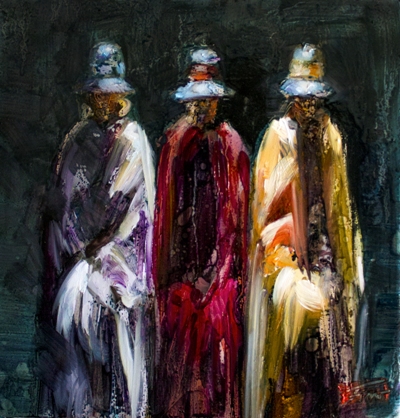
João Fino was a musician, a theater director, an actor and currently focuses on painting which is one of his great passions. His compositions are occupied with the figurative painting that are inspired in his multiple life experiences.
From what I saw through your biography you're almost a renaissance man, you were already an actor, a director, a musician, have created sets for theater and now you dedicate to painting.
John Fino: It fascinates me learning, evolution, the challenge of problem solving. The painting is perhaps the greatest and most beautiful of equations for me.
When I finished high school in the drawing area, my route turned away and remained so multiple, for 15 years. Out of curiosity and survival. By passion or stubbornness. But always felt that the arts are intertwined, even before realizing that thought. What I learned I carry to the next. I'm better musician, I will be best actor, best director, best painter accordingly. The pace the depth of notions of space, the feeling, the musicality in words, sounds or textures in the oil, the different layers of a character in a song or a painting, everything moves in the same direction. What painting teaches me, it is to synthesize, simplify. But I have yet to learn. However, it is undoubtedly the space where I feel most comfortable, I love the solitude that gives me the paint. Cause I enjoy the presence of more people later.
But this has always been your goal, be a painter full time?
JF: The paint is still fresh. Still makes me kneel. At each visit, like a queen. It was a long journey but I feel that I finally got home. The opportunity arose to focus on me in one direction. But since my staging notebooks from the time of academy there are full of drawings. I always drew, I think better while drawing. The creation of stage pictures, the body of the actors or the lyrics always accompanied me. Rouge, my play, my pirate ship, was a showroom addition, all my plays have always had a very strong visual component. Today thanks to the investment of people who believed in my work could finally focus on being just one. And it gives me great pleasure. Now I apply all that I bring with me to my work. I want to be known as Fino, the painter, yes.
The areas where you moves and end up influencing your work, as I noticed that you do a lot of figurative painting.
JF: Yes. It fascinates me much the face of drama and expression of eyes and body. I'm still director accordingly. I stage characters I create, mold them a voice to convey feelings. Also music is a major presence, rhythm, percussion, melody. The colors are notes, strokes set in time of a picture, give you a base to have a voice. In future possibly the figurative will be diluted, unless you want to approach this line very objectively. How would an exhibition of theater.
Also much of your themes have to do with the theater.
JF: The theater is an inescapable presence, I was born on the stage. My work at this stage still reflects that. I love mask, facial expression, love register the feeling, strength and light that theater teaches. The way I paint carries all the way created on stage. First instinct, ever, then the reason to improve this base. The beginning of my paintings is the most pure and honest phase of my work. But I'm also a fan of the structure and perfection, so I like to drive this instinct to a more tailored results. I want the future to do an exhibition dedicated entirely to this universe, the theater.
Edible wild fruits- practical guide


It is the latest publication of Alexandra Azevedo veterinary and environmental activist. This author regularly writes popular articles of opinion, and organizes various practical activities where she highlighting the theme of food.
The new guide on silvestes fruit in Portugal by Alexandra Azevedo arises because "our industrial and urbanized society deeply moved us from the most intimate contact with nature, so the practice of wild foods recollection is practically extinct. These practical guides are directed especially to those seeking a more natural diet and to recover ancestral knowledge, compile useful information in the light of current scientific knowledge, to combine the tradition of food innovation, so editing of these works are the result of a route over the last years of research and especially of many dining experiences. "
The ethnobotanist also believes that there is "a significant diversity of plants that according to archaeological and historical data were used since ancient times. For its exceptional nutritional qualities and abundance, acorns, fruit of the species of the genus Quercus was one of the food which was the basis of feeding of early human populations in our territory, however its culinary uses are unknown to most people now, so it is worth reflecting a bit about how we got into this situation, seeking to better understand where we come from and where we go. Our native forest is very threatened and an aid to recovery will be needed, so in this guide also give additional information for propagation by seed of some species.
This latest work comes after the publication of another practical guide entitled "edible weeds" that also resulted from extensive research on plants, since the researcher states that "the conventional wisdom contains a long list of species used wild plants for food, or in place, or addition of vegetable plants, or as a condiment, and for medicinal purposes. There are gaps in the available literature on the uses of edible weeds directly by their leaves, flowers, stems or shoots, this practical guide seeks to address. "
The luminous


Mafalda Arnauth celebrates 20 years of career with a new album entitled "Mafalda Arnauth and Atlantis." A route in fado inspired by constant learning and evolution as an artist full of light meditate a universe of great talents.
Your last album was "light earth", 2013, which is a curious work, because almost turns the origins of your first album, you write the lyrics and the inspiration leads us to the Portuguese nationality?
Mafalda Arnauth: I really like then, because often things are done without this clear intetion. When I evaluate everything I built, everything fit together, I realize that is the seventh record, it seems almost a cycle of albums experience that's the one from the origins and return there because in this trip is sometimes necessary to return to base, I am really root inspired and defines me as a person and artist. In fact as much as this trip has been made largely in fado, my influences and the vision of my life does not always came down just to that sound and go to what inspires us as Portuguese, the Lusitanian proud spirit of self and with self-esteem that was what I wanted to bring to this record. Hence the light, the need for light.
Even in the arrangements you have done different things, because there are very unusual instruments and not normally associate with fado.
MA: The arrangements, the merit is all of Tiago Machado, because the only thing I asked him was further define the sound of Mafalda Arnauth, who is not just the obvious fado and the Portuguese guitar, viola and bass that are genius and that has accompanied me all these years, but it's like once in a while I like to add the accordion, the percussion and a very rhythmic work I like to feel. It is the attempt to set increasingly my own sound, in my own name and in this next project that will participate this is even clearer that need.
When you intend to set your lines alsothe sound of your voice?
MA: Yes, because the voice has this interesting side. An interpreter is expressed by tone, by word, by the way puts a prayer out here and definitively the voice, its most physical part will be transformed over the years and there are times when it is easier to be faithful to what the voice is to be at that moment, there are others where you've been looking and still suffer this transformation process. This album curiously sense to a more serious, more intense region, many people always told me they liked my middle-range as voice and what I think it is reproduced in sound is something more engaging, maybe it is not so shrill and so immediate and powerful as certain higher voices, but it's a state of mind.
Is that your voice now?
MA: Interestingly not in my next discography project, but it is one of the tones.
Tell me a little about this new album.
MA: By grace the "light of the earth" is a cycle that is completed. And this new album is a rebirth, it's a completely different experience than I have done, not only of content such as processes. I was totally driven by the production of Frederico Pereira, I had a step of confidence almost blind, so let's try, let's clean this, this and this and the person leaves up this process without having an idea of the final result is very interesting. It is a work of giving up the limits of control.
It's too much skin


One more reflection on one of the trends seen over this year.
I could not help noticing in many fashion magazines the emphasis that has been given to a pseudo-cut dresses with transparent fabrics that foresaw all the twists and curves of the various women who wear or undress them? Do not get me wrong I like transparency, but what I do not appreciate is this obsession that I might add is found more in the land of uncle Sam of showing everything from the arms and toned legs, to the contour of the breast, the flat and hard belly and the prominent ass, were worth more they were naked, honestly. I do not consider myself a prude or a moralist, I appreciate the aesthetic beauty of a nude in a particular artistic context, now, what this new trend tends to show is everything in a shameless way and it is appalling. Recently I saw pictures of Rita Ora, Beyonce, Irina Shayk and Rihanna that left me perplexed, I was not concerned with their bodies, which are beautiful there is no doubt it, but it is bad taste to use a few meters of cloth that only cover the essencial. If we approach this issue only from the design point of view these pseudo garments are of unprecedented vulgarity. What happened to the sumptuous fabrics? The devorés and laces that left more to the imagination than showed? Where is the refinement of the finishes, the quality of fabrics and especially the dream worlds of the fashion designers? What consoles me is that in fashion everything is ephemeral ... until the next day.
History of madeira in comics


Three comic books about different episodes on the history of the island of Madeira. A partnership between Agência de Promoção da Cultura Atlântica (APCA) and Roberto Macedo Alves, form the livrary “7a dimensão”, who was in charge of artistic direction of several volumes of this collection, which also aimed to showcase the work of young Portuguese designers.
How did come up this initial idea of several comic books on the history of Madeira?
Roberto Macedo Alves: The initial idea arose from the project partners, was almost spontaneous. There was a range of views framed on the "learn from Madeira" were talking about illustrations, the idea grew, the concept was evolved from a volume to a collection and in the end came to be designed by several people.
It was a brainstorming?
RMA: We talked about what historical content should be represented and accessible to all audiences, because there is nothing like that, what exist is very boring, there are volumes of history of Portugal in comics, but usually young people even in this format, they do not like, because they feel is too heavy, with illustrations of the nineteenth century. The purpose was to take advantage of the fantastic stories that the island has and that few people know in a work that is interesting for younger readers and at the same time that adults could also read, be fun for everyone and still be room for learning. This is how the stories of the "Asterix and Obelix" children read one way and adults discover other subtle details that make these interesting designs, from that we wanted to create a work from kind of a book to a collection and also were designed by several young islanders, it was not just me, the aim is to open doors for artist with talent and we can show that we have a generation prepared and doing quality work.
Why did you choose these three stories in particular? The history of Madeira wine and the attack of a German submarine to Funchal during World War II I understand, but what about the Nun's Valley?
RMA: Everyone has heard of Curral but wonder what the origin of the name few people know. Because there are several humorous stories associated with it, we felt as such one of the obvious choice, because of the content.
I was amusing the connection you made between the various stories of the Nun's Valley, the Catholic inquisition in Lisbon and the end of the universe as we know it.
RMA: I do not want it to be a book of boring stories. Could not be documentary like "National Geographic", because if the end of the first pages readers feel that you are "selling" a story end up not to amused them and is only half way. There is a principle of narrator at the end of comic, but turn off readers, these books all the characters interact with the story in a very discreet manner and the reader just learn something almost without realizing it. Moreover, it is a primary objective in all volumes of this collection, so that the history of submarine is the most dramatic of the series, has a moral story. The Nun's Valley is the most fun.
Podcast
Eventos
-
MMI- Reabertura de aquário dos bacalhaus
 17-09-2016
O Museu Marítimo de Ílhavo reabre o Aquário dos Bacalhaus, depois de um período de obras de...
-
Cineteatro louletano- Programa Dezembro
 12-02-2016
No dia 15, sexta-feira, às 21h00, há uma estreia que resulta de uma coprodução entre o Cineteatro...
-
Teatro Baltazar Dias-Programa Dezembro
 12-09-2015
O último programa do ano que encerra como sempre com música... Feliz ano novo 2025...
-
CCVF e CIAJG- Concertos e Guidance
 06-06-2015
A Oficina desvenda os primeiros dois concertos de 2025, a 18 de janeiro e 26 de fevereiro, no Centro...
Follow Us


Revista Yvi © 2026