
A Look at the Portuguese World


Yvette Vieira
Leonor's ballad


Leonor Telles is a young Portuguese filmmaker who won the award for best short film at the Berlin Film Festival with the film "Batraquian's Ballad " An object of cinema that seeks to reflect and at the same time is a testimony about how the society looks at the Roman community.
When you wrote "Ballad of frogs" was already an initial idea of the script enter the shops and break the frogs?
Leonor Telles: Yes, it started with that idea and then everything else was built around the frogs.
After the screening of people approach you on this issue, the lack of knowledge about the symbology of frogs?
LT: Yes.
That they did not know?
LT: Yes, that made no idea.
And do you think that some of the frogs were there, but not with such intention?
LT: Yes, I think that frogs are not there with this intention, but many others are. The idea of the film is trying to figure out if the frogs were in there with that intention or not, that's what we tried to do and the frogs were from had this purpose.
And how did find out that the frogs that were in these stores had this in mind?
LT: That's part of the film process.
As well?
LT: It is part of my way to make the film and all the preparation.
You did the short film with a special camera, why?
LT: The super 8 was the appropriate format to tell this story, not only have that grainy and colorful, a crude and silly point, had to do also with the theme of the film because it is a silly situation. The film also turns out to be a short story and is related to an imaginary with this kind of old and colorful images that refer us to other time than now.
Having won the prize in Berlin and when deparaste you with your family and friends, among girls, your friends in the community, they looked at you differently?
LT: I have no friends in the Roma community.
But one of your parents is gipsy?
LT: Yes, my father is, not my mother, but it only maintains a relationship with the immediate family, so our relations although nearby were not many.
And what did the said?
LT: I think they were pleased.
Yes and gipsy girls in general have a tendency to leave school early. You, transcend all that.
LT: Yes, but I am gypsy half, so you cannot take me as an example so comprehensive, I think.
Now, you have an award, does it weighs on you very much for your next project? In terms of expectations?
LT: No, I think the awards are good and has a positive aspect that is help in terms of getting financing in an easier way, but we have to relativize and not let the pressure affect us for the next work.
And what is your perspective on the Portuguese cinema? Someone who is coming to the middle.
LT: How so?
It is a difficult way to get support for someone as young as you?
LT: It's hard, but the movie are very difficult for young people to start. If people work and try to create their own opportunities little by little the doors will be open and there are new prospects for younger people. People have to work, continue to fight and if you have few means try to compensate in other ways, but you have to make films and take things forward.
And as a spectator how do you see the Portuguese cinema?
LT: I think sometimes the filmmakers are good and are not known because of the prejudice against the Portuguese cinema, because it is boring and dull and so no one has an interest, but these people have to be more flexible, open more and are more predisposed to see new things. Maybe so they would like more what the Portuguese do, because there are very good cinema that is made and then they not have places to be seen.
Do you have a reference filmmaker?
LT: I like Miguel Gomes .
And your generation looks to the national cinema as something less boring and that you can see?
LT: I think my generation depends, on the people working in cinema of my age look at it with different eyes, will see the film and try to understand. We also have a training that makes us see the film as it is something to think about and not just as entertainment. My friends do not have this perspective, for them, cinema is something to entertain, do not see it as an art form to think and reflect things.
In your next project you will continue to use the super eight camera?
LT: No.
You'll use another format?
LT: Yes.
And you will continue to make the circuit of festivals because it is the only way to be recognized?
LT: I do not know if things can be put that way. People when they compete for festivals out there is good for some recognition and if there is success on the international festival circuit, will certainly open the doors to their debut film commercially.
Are you going to continue in the short format?
LT: I think so.
But, you have the idea of making a feature film in the future?
LT: No, my goal is to do one project at a time, working on the things little by little and the best way.
And always in this kind of documentary record?
LT: Yes, I think What I have to show more is this documentary part, but at the same time mixing some other records, if we look at "Batraquian's Ballad" is not exactly easy to characterize the film.
Portraits of the chaotic mind


Andé Gonçalves is a young conceptual photograpy artist that makes us dive into surrealistic and deep scenarios and characters that almost whisper secrets and transport us to other worlds.
Why this exhibition?
André Gonçalves: I've done two other exhibitions before, but one of them was included in a collective. In Madeira have to basically promote us, I decided to send emails to various institutions, museums and cultural venues and got a response of Baltazar Dias theater.
What is the thread of this show? The photos refer to a gothic setting.
AG: I do not have a style, I have an identity created obviously, but I have several themes from the surreal, conceptual and still have pictures. I do not have a defined style, but I approach various topics of the photograpy and try to exploit them to the fullest.
Regarding the photos, you set a scenario and then inserts the characters? Or is there a story and then you build the picture?
AG: No, despite my images convey this idea is never so. When I'm shooting I never have a basic idea, just let me go, but I have a trunk and when I shoot take everything with me and then use what I think is best suited to the scene, or have a very basic idea of what I'll do . I'm not a photographer and I do not consider myself as such, what I like to do is image manipulation and is where I do almost all my work, which appears in the composition of the image, trying to convey a message through photograpy.

It is curious that underline this issue, because it is clear that there is a technique behind some almost tenebrous images.
AG: Yes, as I said I do not consider myself a photographer, but I have to take the pictures because it is the starting point of my work, I use photoshop, the images almost changed the whole, I do not run much away of the reality of the scenarios, it is as before, but then I distort the landscape in an almost cinematic effect, but in my opinion real.
You also have many self-portraits, why? I recalled that algns artists did this kind of work, first for lack of subject to paint, but also to determine the technique is that the case?
AG: Yes, I began with the self-portraits, but it's not for lack of work, I like me and do them.
You have considered a designer? Or artist?
AG: Artist yes, no photographer, no designer no, because I'm self-taught, I honestly do not have a definition, perhaps handler of images.
And what is your next step after this show?
AG: I have Scheduled an exhibition at the beginning of next year at Fnac, there will be for three months.
Fires destroy portugal


Fighting the flames once again mobilizes thousands of professionals and people themselves.
More then 4, 000 professionals were in the ground all over the country, including on the island of Madeira, fighting fires that plague the country since the beginning of August. Altogether more than 180 fires swept through thousands of hectares of forest and just to get an idea on the island of Madeira, in Funchal, 150 homes were consumed by flames, there is 3,078 housand hectares (ha) of burned ground and unfortunately there three victims to mourn, also Calheta burned 28% of its territory a total of 3,200 ha. In the mainland, to the north, a total of 16.660 ha of land were consumed by flames in the towns of Caminha, Arcos de Valdevez and Viana do Castelo. In the center, in Agueda and Anadia 10,328 hectares were burned, the fire São Pedro do Sul approximately burn a third or a quarter of its 250 square kilometers of its territory and in Arouca, in Aveiro district, 831 professionals have been mobilized and 256 terrestrial means and in total were destroy 17 housand hectares of land.
The European information system for forest fires (EFFIS) that analyzes satellite images that records the fires in real time from the beginning of the year until Friday, August 12th, states that only in Portugal already burned more than 101,000 hectares of forest, equivalent to 101,000 football fields. Only our country is responsible for half of the area burned in all 28 European countries have been buffeted by forest fires this year. The European Observatory also states that this average 2016 exceeds the burned areas in 2008 and 2015 stood at around 25 000 hectares burned, data that meets the doctoral thesis of Ricardo Ribeiro, defended in the European University in Madrid, in which he assessed the result of ten years of implementation of the National Plan for the Defense of Forest Fire as being negative and ineffective.
"Desertification is a critical risk factor that is never addressed. But there is a direct relationship between population density and burned area, large fires occur in inland areas where there was an exodus to the coast", told Lusa the responsible, who is also the president of the Portuguese Security and Civil Protection Technicians Association (Asprocivil). And he warned, "the paradigm of fire will change dramatically in the geographical and chronological point. It's just that, he said, climate change, fires will no longer be a summer problem and will also extend to other areas of country, far more spared ".
In the study of more than 600 pages, which admits might be published, defended as fundamental, prevention policies and remember that in 2013, burned down in Portugal half of all the area consumed by flames in Europe. One reason, he adds, is the "precariousness of the conservation of forests", together with the rural exodus, the construction of housing in hazardous locations, the effects of climate change and neglect of people. Ricardo Ribeiro proposes that the good practices of the population is subject of the education system and that there should be advertising campaigns. Firefighters should also have more training and should be created a public system of incentives for regional planning and biofuel cleaning, for which intervention teams should be created. Focusing on creating an Iberian market of biofuel, further "punitive action" implement permanent means of fighting fires from March, creating social measures for people up to 50 years to combat desertification, create tax incentives for securing young people in the field or invest in video surveillance are some of Ricardo Ribeiro proposals.
The official specifically argues that the same as for fire-fighting intervention teams are created to act in the dead of winter, creating intervention and prevention measures, and that the land along roads and houses are actually clean. "In this issue, there is prevention, response to fire, and the restoration of normality. But in Portugal, it focuses specifically on the response, forgetting the prevention and restoration of the forest," said Ricardo Ribeiro to Lusa, adding "Portugal was the European country least reforested in the last 20 years."
Nor does it appear that burn on average each year 150 000 hectares of forest, or in 2013, burned down almost half a million hectares, he recalled, adding that between 2002 and 2013 died because of the fire, 97 people, 51 of them firefighters. And even then, he told Lusa, no behavioral changes or there is an effective planning, forgetting politicians that when "close a health center, are to encourage people to go away." The fires, like those of recent days, causing an annual average loss "more than two hundred million euros", plus another 200 million in environmental and material losses, said the official.
Memories of Martha


The Mudas, Museum of Contemporary Art of Madeira features in the old main house, the new temporary exhibition space, the work of artist Martha Cohen da Cunha Telles.
This is a Expolio of 31 works, including painting, watercolor, etching and screen printing, which the Regional Director of Museums and Heritage Services of the Regional Directory of Culture, Francisco Clode are "a tribute to an artist born in Madeira that made her career in Porto, Paris and later in Canada".
The body of work the artist was donated by her daughter Teresa Cunha Telles Hall following a transfer protocol for 10 years with the Region, extended for five years, an agreement of great importance because, as the responsible said, Martha Telles besides being "a teacher, an educator, she lived all her life with the memory of her childhood. His work reflects this, not in the sense of a naive painting, but a work that rises to her childhood and she herself lives in this melancholy, is seen as a child reflecting on the adult condition. All her life she lived this drama, the big kid that she was, the life she left and that she efabulou. Agustina Beça Luís wrote about her and her memory narratives are not reality but a fiction, because all memory is that and in the background the work of Martha Telles is thus fiction of what we are to be something different. It is a tribute to this deep love she had for her homeland. "
Born in Funchal, August 19th of1930, the daughter of a madeiran lawyer and a Danish opera singer, Martha Cohen da Cunha Telles, after a brief initiation to the landscape painter Max Römer in her homeland, studied painting at the School of Fine Arts in Porto, obtaining the diploma of special and higher course. Between 1963 and 1965 was a scholarship from the Calouste Gulbenkian Foundation in Paris, where she studied painting under the guidance of Maria Helena Vieira da Silva and Sociology of Art at the Sorbonne.
After a brief stint at high school went to Copenhagen in 1961, where she made his first solo exhibition. In this city, along with the painting, also worked as a technical designer, activity that had already practiced in Porto. In 1968 she moved to Montreal and then continued studies. Shee obtained a bachelor of fine arts at the University of Quebec, attended the course of engraving at McGill University and was a scholar of the Council of Canadian Art. Naturalized Canadian in 1974, after sixteen years in this country, she returned to Portugal in 1983. She even lived a season in Belgium and died on February 21st of 2001 in Lisbon.
The exhibition of Martha Telles represents the second phase of the transformation of Mudas space that has been gaining more and more visitors since its opening in October of last year, in particular by foreigners visiting the island of Madeira, about this matter Francisco Clode enfazises that "sometimes we have the idea that tourists have little information and do not know anything about heritage, but you know, just making choices. We have a higher average of over 1,000 visitors per month. There are days during the week in which the museum is visited by more than 150 people, an average that we hoped will reach the 25 to 30 thousand visitors year. This year alone we can look at the numbers of Mudas because before was only an exhibition center, was not exactly a permanent collection. There is a renewed interest in cultural offer, people see the nature and the sea, but increasingly are interested in the heritage ".
The trapezist of comedy


César Mourão is an actor who takes on various skins, but it's the comedy that feels more at ease. He consideres himself a kind of artist without a net, or the kind of comedy that he exercises in terms of the course of his career.
You started with Herman José and now you have a film and do you think that this is the career that you intended?
César Mourão: It's all right, but seven years before Herman José I had my career. I did not start with him, far from it, it was an important part of my career obviously, so I'm a huge fan and always have been. Nowadays, I do not think much along the way, like to do things that feel good, above all theater, then film and television at the end, but that are completely different jobs and shapes.
You have considered a comedian?
CM: No, I consider myself an actor. A comedian or comic does not have to be an actor, my work and training in the art of representation and if I have to make a movie with a dramatic character I can do it. The humor appeared inadvertently is a beach where I feel very good and gives me much joy, I do it more today.
You think that because you have been so successful in this comic area that you stay cataloged in this aspect and they offer you only comic work?
CM: Yes, in this movie "Song of Lisbon" my character has a lot of humor, he has a dramatic arc that also happens and is not just a mood log, there is a serious side and I still sing and that's fun. In the "Song Coutryard" on the contrary there was not a lot of humor, maybe it was the character with less favor between all the cast it was there. So I am very proud to be cataloged as a comedian and I like to be a humorist, just I am also an actor and with this I can do other things than these.
Then you consider like many artists do stress that humor is much more demanding to the actor, because it's harder to make people laugh?
CM: I do not know if it's more difficult than I think it is that depends on how each one faces it. When making a scene with dramatic air if people are silent in a room we interpret as are really enjoying because you do not hear a peep, if we go to the cinema and see a dramatic film people are also quiet, we deduce that are really enjoying. In comedy is immediate, people laugh at you and you think they like it, if they do not laugh they did not like it, it is easier to assess whether or not it works out. I, for one, am a comedy viewer that never laughs, I'm not a person that goes out of a show and laugh and sometimes I think it was spectacular and even say it's the best things I have ever seen and there are many people that they are like that. Now, if we have many people like that in a comedy show, at least two hundred people, I know it's horrible. It has not to do with the fact that people like it or not, but with the fact that we admired it and not we could laugh about it, comedy is more immediate one liked, or not and the drama is silent we infer they enjoyed the dramatic scene but it may not be what happens.
So, now you enter the are of stand-up?
CM: I do not enter. Let me correct, I do not do stand-up and never did. This form of comedy is a text that is written at home with already prepared jokes and one goes up to a stage with all that stuff on certain subjects. What I do is improvisation, I come, I have nothing absolutely prepared, make a improvisation or another, call a person to do a song about your life and none of it is prepared, it is improve comedy, theatrical improvisation, not in absolute term because it is not a show, but it is not stand-up, I do not do it and do not even have the talent for it.
Because it is a show witout a net, what happened when people do not like it?
CM: Never happened to me, fortunately. The challenge is that when we go to a circus we give more value to a trapeze artist, and we do not know why, that do their number without a net and not as much when an artist has a net below. Both have value, because the maneuvers are also dificult, only one has the net and the other is without any security and there is no difference. What I do is no different than my colleagues do, it is a complicated work, is another type, because in theirs there is a text and are off the hook because they know what they will talk about, I just do not, are the same maneuvers but without the net.
And you never have blanks?
CM: It's impossible to have a blank when I have nothing to say. Therefore, I cannot forget what I have not to remember. As I have nothing to memorize, there is not a blank, there may be only silence, but these exist, because the art in comedy is timing and not the joke that is been writing there. If I give a text to a security of a shoppping and give it to Raúl Solnado, the same words with the same commas will not be so funny in thesecurity voice, at the outset, on the other hand, they will have immense humor with the comedian. It is not what is written is the timing that is done, the dexterity with which we foward the public and not what the public think you're going for.
In all these areas where you move the theater is your favorite room?
CM: Yes, my favorite area is the theater. It's amazing to have that ability to take the audience to laughter as I want and where I want and not what they think will laugh and that's amazing. The magic of television and film are incredible, I prefer the latter, is more magical and a maneuver.
Let's talk about "Song of Lisbon", what were the challenges of such an iconic character, perpetuated by Vasco Santana?
CM: Actually the challenge was not very great, because it is not an imitation of Vasco Santana, I have no weight and the actor had a lot. I have only pride and respect because he played it. Now, the film is not an imitation, wants to be something else and has the capacity to be another movie, but has the same premise, that is, a person who studies medicine and does not study anything, aunts judge he is a doctor and he is not. The challenge is the same, but it is done differently, is the same thing If I asked you to draw a sunflower and a girl from Bangladesh, will be two different flowers.
Yes, but like all Portuguese of several generations, surely you saw this movie more than once, you end up always have in it in the back of your head the character that is unforgettable.
CM: Yes and is unforgettable and there are some parts of the movie that I "word for word" on purpose, the part of the exam is transcribed exactly from the film is a tribute and I am calm by not having to imitate.
Detainee


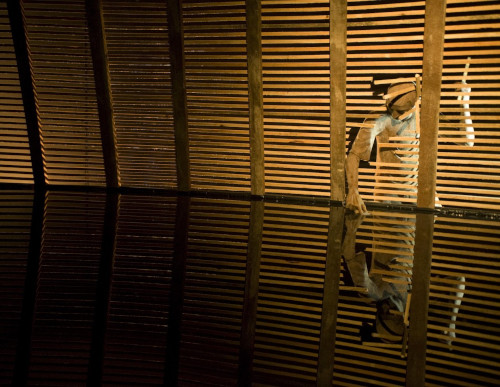
This is a short film of Diogo Brazão which focuses on the duality of space almost frozen in time, as opposed to the world passing by, always on the move, always changing.
How did arose the idea for this film? I realized that it's about your father.
Diogo Brazão: Yes, the idea came for the discipline in ESAD (Superior School of Arte and Design) and as I had a free theme I chose the life of my father, who I knew through family that he had ambitions and wanted to be someone else. Not like I knew him like someone working in a grocery store, but had the dream of being a doctor.
He never told you about it?
DB: No, then I started to relate things, the space, all the feelings that is of being tied to a place against his will, having to ...
Be detain?
DB: Yes, as the title suggests. And from there it began the process of this work.
It is also a portrait of loneliness? Because in the film is clear that throughout the day your father is always alone.
DB: I created analogies also as a creative process, for example, I wanted to convey the isolation, the space itself almost covered him, overwhelmed him in contrast to the street, because the movement of the car is constant, there is the sound.
There is another issue that stands out is the fact that it is a traditional trade that this dying.
DB: Yes, there are few, but it's what he knows, it's his life.
What about the rest? We realized that it was a small space.
DB: Yes, I just filmed a small part because it was what I wanted to focus on, the window, the central space.
Your father never told you about his dreams?
DB: No, no.
It was difficult to address him about this project?
DB: No, it depends on the child and the parent relationship.
And when he first saw what was his reaction?
DB: There was not any kind of reaction, I was waiting for something, but no.
Were you disappointed with that?
DB: No, as I know my father, it was something natural.
And outside your family what they said in relation to your short film?
DB: They liked, but was more support.
Portugal has the best beaches of europe


The country stands out for the quality of water of its beaches and inland bathing areas.
This year, the annual report on the quality of coastal bathing areas and freshwater, reported by the Member States of the European Union, prepared by the European Environment Agency (EEA), in cooperation with the European Commission DG Environment, congratulates Portugal for the water quality of the national beaches.
The report assessed the quality of bathing water in all 28 Member States of the EU, Albania and Switzerland of the previous season of 2015. The document indicates several areas where it is expected that the quality of bathing water is good this year, Portugal stood out because 94% of bathing water is of good or excellent quality. A very positive statistic given that only in our country this year there are 71 beaches with zero pollution, as reported earlier by our magazine. The EEA put even a post on its Facebook and it became viral registering thousands of 'likes' and more than 2,300 shares, and comments of several Portuguese, as well as foreign citizens.
More information on water quality in Portugal and other European countries: http://www.eea.europa.eu/.../sta.../state-of-bathing-water/state
The beautiful anvers


Come and learn a little about the second most important city in Belgium.
Antwerp is a city with many facets, because of the influence of various cultures that converge in this large city and in the country, so do not be surprised it has two names, the most common name has a Flemish origin and Anvers is the French version but the mulcultural enviroment and affability of the belgian make this an irresistible and unusual metropolis. To begin this tour, your visit should be made by train, without any doubt, in order to have the privilege of entering one of the most extraordinary stations in Europe, not only for its aesthetic beauty, as architectural, because it has four floors inside, it is true, it seems unimaginable, but it is possible. Several trains come and go in several plataforms, at different levels, and we have to access the platforms by a treadmill is simply fabulous! The building itself is gorgeous adorned by stone columns and structures of steel and glass, a fusion of old and new that come together in a remarkable way. At the exit we literally stumble with one of the great and eternal loves of women, diamonds. Even on your left begins the Jewish neighborhood with dozens and dozens of crowded stores with these gems in the form of jewelry, or the sale alone, with prices varying depending on the weight, color, purity and its polished, yes, there's no denying it, a woman always knows what pleases her and what better adorns hers! After a long sigh of sadness, nothing better for frustration than another great passion, shops and shops of Belgian chocolate, one of the world's best, along the Leys Avenue, packed with traditional trade and beyond.


Making a small deviation in one of the cross streets, you can visit one of the most famous houses of this city where it lived one of the great painters of Belgium and the world, Peter Paul Rubens. The museum is interesting and not only you enjoy some of the pictorial work of this Flemish artist, his friends and assistants, as we peek at the beautiful interior of this preserved space that dwelt with his family. One of the most curious aspects and in good state of preservation is the "wallpaper" which is made of tufted leather, yes, only the rich could decorate their walls in this way and this is visible throughout the interior as well furniture some of which inspired by the baroque and imagine, a press for linen.
Another must-visit is the Grote Markt, a square where is the town hall, a Flemish Renaissance style, as well as the cathedral of Notre-Dame of Antwerp, just in front of one of the most beautiful monuments of Gothic in Europe and the highest of the city with 123 meters high and is worth visiting its interior if only for its magnificent stained glass windows and Rubens works. All of these edifications and the surrounding historic buildings are classified as world heritage by Unesco, and I might add deservedly.
One of the leaflets to tourists I found another information at least curious, a church built by the Jesuits, São Paulo, which is considered the eighth wonder of the world, was there lurking and that title is due to the amount of marble that adorns the interior, I cannot say I was rendered or disappointed, but it's worth a visit if only for its artistic value. My digression could only end with the estuary of the Scheldt River in Her Steen one of the oldest fortresses, built to thwart the attacks of the Vikings, one must not forget that Antwerp is from Roman times one of the most important ports Europe, so you must walk along the walls where may spot the landscape across the border and at the end there is a modern building, the Stroom of Aan museum, a 10-story contemporary structure that have several rooms for temporary exhibitions, shops and the top has a panoramic city view for later recall.
Hats are many


With summer on the door step nothing better than a hat to refresh the ideas.
The origin of the hat is intricately linked to the need to cover and hold the hair, hence the origin of its name in Latin, "Cappa" or "capucco". The first models come 4000 years ago a.c., in ancient Egypt, Babylon and Greece and were no more than a band of tissue attached to the head. Currently this narrow strip is placed around the crown of the present hats, ribbon or bandana, which is a remnant of this first prototype. The first effectively used hat was the "petasos" around the year 2000 a.c. It was a hat equipped with low and wide-brimmed cup that the Greeks were using in their travels as a form of protection. It was a practical, adjustable types and can be removed easily, having persisted in Europe throughout the Middle Ages.
The curious fact about the history of this fashion accessory is that the primal hat came only by the need to cover the head, over the centuries has been determined in its various forms and sizes as a matter of social status, the clergy and the nobility used it to distinguish itself from other classes and as a sign of their wealth.
Regarding the evolution of female models these arise from the imposition of the clergy, it was necessary to cover the head and the hair out of modesty and respect, according to the book the story of the hat, "the simplest shelter consisted of a piece of linen, fallen on the shoulders or below them. The bridal veils and headdresses of Spanish are survival of the fashion of that time. In the thirteenth century, it is wont to hold this veil, two tracks, one on the chin and another on the forehead, similar to the habit of the nuns still retain. At the end of the Middle Ages it was customary for women to put a wire frame with heart shapes, butterfly, etc. under the piece of cloth making them extravagant. His hair was slicked back, hidden, and it grew on his forehead were shaved so that the hat was the main attraction. In 1500 one begins to use hoods adorned with jewels and embroidery. Many other types emerged by the end of the eighteenth century, when it appeared the first cloakroom, shops where they sell hats that used in its hats materials such as straw, felt, fabric, varied and elaborate decorations to combine with hairstyles highly sophisticated of the time. "
The hatters become so one of the most important crafts over the centuries, which reaches one of its peaks in Edward VII period of England, Queen Victoria son, when the so-called Flamboyant hats arise because of the use of birds and their feathers as adornments. "By using use a type of poisonous chemical, mercury base, to treat and preserve the brightness of the feathers of birds used by the ladies of the court of the Edwardian era these professionals were contaminated by heavy metals that were attacking their central nervous system. The toxicity of this chemical was such that many artisans had symptoms of severe damage to the central nervous system, such as St. Victor dance syndrome characterized by continuous involuntary movements of the muscles of the face and extremities, reaching seizures " quoting the publication . Hence the use of the expression "mad as a hatter" which was enshrined in one the characters of the famous children's story "Alice in Wonderland". With the passage of time hats gain even more notoriety and the industrial era become a more democratic accessory.
Currently, they can be manufactured in various shapes with various materials and designs, but its use fell from daily to punctual, or is only used in important ceremonies, or as a fashion accessory. Interestingly, one of the most popular male models, the famous Panama, is now used by women and continues to be a success worldwide, because not only is synonymous with tropical temperatures, as for its elegant shape and finish, but there are many more designs and materials that extend the range of adornments for the head, just choose and use it.
The time of perfect loves


It is a historical novel by James Rebelo that brings us to the Angola of the late nineteenth century.
I started reading this book at the suggestion of a colleague, although a diehard fan of books with a historical aspect, I recognize that never had wanted to read the so-called Portuguese "Nicholas Parks" until "the time of perfect love" and I must say this writer is well above the American author. This work, in particular, focuses on the life of Lieutenant Carlos Montanha and his prohibited love by Leonor de Carvalho, in the Angola of 1897 and I must say that it is a novel of epic proportions. Tiago Rebelo's prose is of great beauty stylistics, the characters are fascinating in their ideossicrasias and the drama structure itself is exciting , which makes it an addictive reading. A curious fact of this novel is that it is based on real facts, Carlos Augusto de Noronha Montanha existed and left for posterity a book titled "Odyssey of a colonial pioneer in the hinterlands of Angola" which describes his adventures on the African continent serving as a reliable basis for this novel about a troubled time in the history of Angola. But this perhaps is not the most important, in my view, the most remarkable aspect of this work is that the main character is an ancestor of James Rebelo and was the author's brother, Francisco Rebelo Montanha in its genelogy investigations not only discover the valorous family member and his small publication, removing it from obscurity, as also urged the writer to write about it and two years after this discovery came the "time of perfect love." I do not wish to say anything more about this remarkable story, I can only add that it is worth reading this adventure that has the background of a former colony in the late nineteenth century, where takes place a great devourer and voracious love as the landscape itself from Angola. Have a nice reading.
Podcast
Eventos
-
MMI- Reabertura de aquário dos bacalhaus
 17-09-2016
O Museu Marítimo de Ílhavo reabre o Aquário dos Bacalhaus, depois de um período de obras de...
-
Cineteatro louletano- Programa Dezembro
 12-02-2016
No dia 15, sexta-feira, às 21h00, há uma estreia que resulta de uma coprodução entre o Cineteatro...
-
Teatro Baltazar Dias-Programa Dezembro
 12-09-2015
O último programa do ano que encerra como sempre com música... Feliz ano novo 2025...
-
CCVF e CIAJG- Concertos e Guidance
 06-06-2015
A Oficina desvenda os primeiros dois concertos de 2025, a 18 de janeiro e 26 de fevereiro, no Centro...
Follow Us


Revista Yvi © 2026