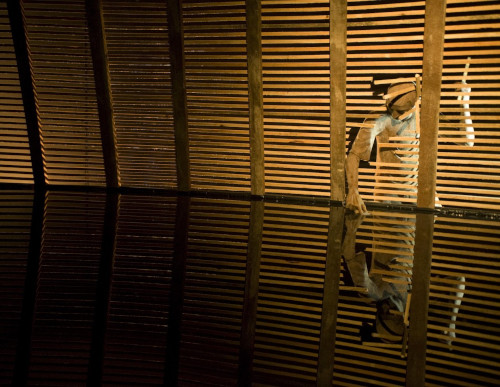
Luis Amin develops a work that focuses on the deconstruction of the art tile. It equates it to a logical manifestation of art. Transcends its more traditional way to turn in a more abstract but no less Portuguese in its essence.
What you sought to address?
Louis Amin: Getting my work I have been developing for more than twenty years, wanted to pay tribute to people I knew from childhood that marked me for life and had a reflection in terms of art. It is this peace of mind. This way of being in life. It's about people that was where I lived in the Faja da Ovelha and Ponta do Pargo. This piece is more directed to those people were I lived.
It means that the island influences his work?
LA: Yes, somewhat. In personal terms, and the human I am today. The simplicity that is not what it seems, everything has the complexity of life. This translation of simplicity in which these people have contributed. Hence my honor. And throughout the life cycle that involves the field. The culture that surrounds them for centuries that applied at the time. From sowing to harvest. Everything was cyclical and was part of life. This struck me a lot and causes me an emotional balance. It's something more transcendent that culture, something more gothic, as was this artistic movement of the middle ages. Like stained glass that reflects that life. The blue of the mountain and the sea. Then the sun is yellow and black power which is a development of life. It's all very symbolic.
As an artist are you influence by the island the rest of your work?
LA: I do not know people can have that opinion. Simply, I work in a Portuguese culture. Develop the work of the tile. The idea of the concept as an object, such as traditional. I think of the logic that it brings those lines and abstraction. From there with letters construct, deconstruct and reassemble. Create a unique language that has much to do with the Portuguese culture and its Arabic influences. My painting is very focused on this point.
What do you want then?
LA: The logic of the object which is tile. When you look at his picture, this realistic drawing and abstraction. In Lisbon, where I live, the buildings are filled with houses, homes covered with tile. And it all came from the eighteenth century to the present day. All of this goes unnoticed by people, but it is very Portuguese.
Did you a lot of research when addressing these issues?
LA: Yeah, I and a great friend, Antonio Aragon, walk a lot, day after day by the city of Lisbon. He described to me the story of all those parts, because he was an individual of great culture. He was an information base to the historic level and using that legacy he left me to develop my work.
O que prefere então?
LA: A lógica do objecto que é o azulejo. Quando se olha para a imagem dele, o desenho realista e o abstraccionista. Em Lisboa, onde vivo, os prédios estão cheios de casas, de residências revestidas a azulejo. E tudo aquilo veio desde o século XVIII até os nossos dias. Tudo isso passa desapercebido pelas pessoas, mas que é algo muito português.
Faz muita pesquisa quando aborda essas temáticas?
LA: Sim, eu e um grande amigo, António de Aragão, fartávamos de andar, dias a fio pela cidade de Lisboa. Ele descrevia-me a história de todas aquelas peças, porque era um indivíduo de grande cultura. Ele foi uma base informativa ao nível histórico e uso essa herança que ele me deixou para desenvolver a minha obra.